What is Ascensiontide?
Ascensiontide is the brief but theologically dense period of ten days between the Feast of the Ascension (the fortieth day of Easter) and the Day of Pentecost (the fiftieth day). It is a season within a season — contained within the Great Fifty Days of Eastertide — and carries a particular quality of expectant waiting: the disciples have watched their risen Lord ascend to the Father, and they wait, as he commanded, for the promised gift of the Spirit.
The Ascension is not, as it is sometimes misread, a departure — a sad farewell. It is an enthronement. The risen Christ, bearing the marks of his passion, is enthroned at the right hand of the Father as Lord of all creation. The Ascension is Easter's completion, not its contradiction. The Church's task during Ascensiontide is to hold together both the joy of Christ's enthronement and the weight of the commission he has left with his disciples.
"He was taken up before their very eyes, and a cloud hid him from their sight. They were looking intently up into the sky as he was going, when suddenly two men dressed in white stood beside them. 'Men of Galilee,' they said, 'why do you stand here looking into the sky?'"
— Acts 1:9–11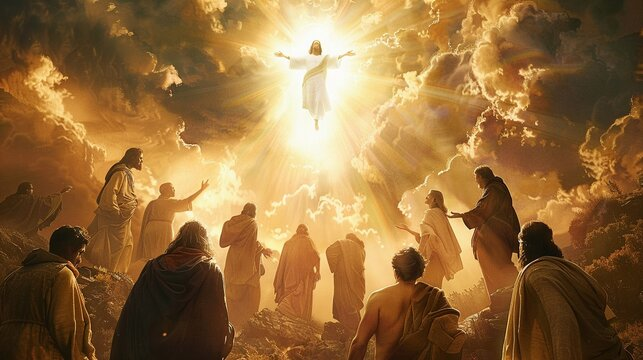
Liturgical Colours of Ascensiontide
White
The continuing colour of Eastertide — resurrection joy, purity, and the light of the enthroned Christ
Gold
Permitted as an enhancement on the Ascension itself — the colour of heavenly glory and royal enthronement
Red
Pentecost Sunday — the fire of the Spirit, the blood of the martyrs, and the missionary passion of the Church
The Feast of the Ascension
The Ascension of the Lord is a Principal Feast of the Anglican calendar — one of the seven great feasts that rank above all others. It falls on the Thursday of the sixth week of Easter (forty days after Easter Sunday), though in many parishes it is lawfully transferred to the following Sunday to allow the full congregation to observe it.
The Feast of the Ascension
Thursday of the Sixth Week of Easter — a Principal Feast
The Ascension Eucharist is a festive celebration that draws on the fullness of Easter joy while introducing a new theological note: Christ's universal lordship. The readings — Acts 1:1–11, Psalm 47 or 93, Ephesians 1:15–23, and Luke 24:44–53 (or Mark 16:15–20) — together paint a picture of triumphant enthronement and apostolic commissioning.
- The Commission — The Ascension narrative in Acts 1 is inseparable from the Great Commission: Christ does not ascend and leave the Church alone. He gives the Spirit and commands witness "to the ends of the earth." Preach the Ascension as empowerment, not abandonment.
- The Gloria and the Alleluia — Both continue in full force; the Ascension is still Eastertide. Do not allow the change of note to diminish the festivity of the liturgy.
- Incense — The use of incense on the Ascension is a centuries-old tradition, signifying the ascending prayer of the Church and Christ's entrance into the heavenly sanctuary.
- The Paschal Candle — In many Anglican traditions, the Paschal Candle, which has burned throughout Eastertide, is extinguished after the Gospel on Ascension Day — a powerful sign that Christ's visible presence has been withdrawn and the Church now awaits the Spirit. Others keep it lit through Pentecost; both customs are defensible.
Rogationtide
The three days before Ascension Thursday — for creation and labour
Rogationtide (from the Latin rogare, to ask or beseech) falls on the Monday, Tuesday, and Wednesday immediately before Ascension Thursday. It is one of the oldest observances in the Western Church — an ancient custom of processing through fields, farmland, and parishes to pray for God's blessing on the crops, on work, and on the created order.
In an urban context, Rogationtide may be observed with a beating of the bounds — a parish procession through the neighbourhood — or with services focused on environmental stewardship, the theology of work, and the blessing of homes and workplaces.
- Outdoor Processions — If weather and geography allow, consider a short outdoor procession around the parish, pausing at significant points to pray for the neighbourhood and its people.
- Litanies and Biddings — The Rogation days are traditionally observed with the Great Litany and special collects for the fruits of the earth, for those who work the land, and for the care of creation.
The Novena of Pentecost — Nine Days of Prayer
The ten days between Ascension and Pentecost are the original novena — nine days of intentional prayer. In Acts 1, the disciples return to Jerusalem and devote themselves "with one accord to prayer" (Acts 1:14) in the upper room, waiting for the promise of the Father.
Clergy are encouraged to mark this week with daily prayer services — Morning Prayer, Evening Prayer, or a simple gathering — building toward the great feast of Pentecost. This is an ideal period for parish prayer vigils, for teaching on the Holy Spirit, and for calling the congregation to renewed expectancy and intercession for mission.
The Sunday of the Seventh Week of Easter (the Sunday after Ascension) carries the Gospel of John 17 — Christ's High Priestly Prayer — a text of extraordinary depth for the waiting Church: "As the Father has sent me, I am sending you."
The Days of the Wait
Between Ascension Thursday and the Day of Pentecost, the Church observes a week of prayer and expectation. Each day carries its own quality within the tradition of Ascensiontide devotion.
The Great Commission Received
Reflection on Acts 1:8 and the scope of the Church's mission. Prayer for boldness in witness and for the renewal of the Church's sense of call.
Prayer in the Upper Room
Acts 1:12–14 — the community gathered in prayer. A day for intercession, especially for Christian unity (echoing Christ's prayer in John 17) and for the leaders of the Church.
Sunday after Ascension — Christ's High Priestly Prayer
John 17 in all three years. The principal theme is unity and the world's coming to faith through the witness of the Church. A fitting day to pray for ecumenical relationships and for the diocese.
The Novena of Pentecost
Daily prayer services building toward Pentecost. Traditional themes: the promise of the Spirit, the gifts of the Spirit, the fruits of the Spirit, mission, repentance, and renewal. Parishes may hold early morning or evening gatherings throughout this week.
The Eve of Pentecost — Vigil of the Spirit
The Saturday evening before Pentecost may be observed with a Vigil of Readings and Prayer — analogous to the Easter Vigil — tracing the Spirit's action through Scripture from creation to the promise of the new covenant. Baptism and Confirmation are fitting at this Vigil.
Preaching in Ascensiontide
The great homiletical challenge of Ascensiontide is to resist two misreadings: the Ascension as a sad goodbye, and the waiting period as an awkward gap before the "real" feast of Pentecost. In fact, this ten-day stretch is one of the most theologically fruitful seasons in the year for those who know how to inhabit it.
Preach the Ascension as empowerment: Christ at the right hand of the Father is not distant — he is enthroned as cosmic Lord, interceding for his people, and preparing the gift of the Spirit. "It is for your good that I am going away," he says (John 16:7). The Church in the upper room is not bereaved; it is expectant. The best Ascensiontide preaching holds together the grandeur of Christ's enthronement with the intimacy of the promised Spirit — the two hands of the one God, reaching toward his Church.
What is Pentecost?
Pentecost is the fiftieth and final day of Eastertide — the culminating feast of the great season of resurrection. It commemorates the outpouring of the Holy Spirit on the assembled disciples in Jerusalem, as recorded in Acts 2, and is often called the "birthday of the Church," though it is more precise to say it is the day the Church received her power for mission.
Pentecost is, after Easter, the greatest feast of the Christian year — ranking above Christmas, above Epiphany, above the Ascension. It is one of the three stational feasts (with Easter and Christmas) at which Baptism and Confirmation have traditionally been administered. The imagery of the day — wind and fire, many languages and one proclamation, the boldness of the formerly frightened disciples — is among the most vivid in all of Scripture, and the Church's liturgy exists to plunge the congregation into that same wind and fire.
"When the day of Pentecost came, they were all together in one place. Suddenly a sound like the blowing of a violent wind came from heaven and filled the whole house where they were sitting. They saw what seemed to be tongues of fire that separated and came to rest on each of them."
— Acts 2:1–3
The Day of Pentecost — The Feast of the Holy Spirit
The fiftieth day of Easter — the birthday of the Church's mission
Pentecost Sunday should be celebrated with every resource of festivity, music, colour, and congregational energy at the parish's disposal. Red vestments and hangings should be used throughout the church — red flowers, red banners, and every visual cue available to signal that this is a feast of fire. The contrast with the white and gold of the preceding weeks is itself a liturgical statement.
The principal reading is always Acts 2:1–21 — the account of the outpouring at Jerusalem. The Gospel in all three years is drawn from John's farewell discourses (John 14–16 or John 20:19–23). The Sequence Hymn Veni Sancte Spiritus ("Come, Holy Spirit, Come") — one of only five sequences surviving from the medieval liturgy — is proper to this day and may be sung before the Gospel.
Where the Paschal Candle has remained lit through Eastertide, it is extinguished after the final dismissal on Pentecost Day — a moving sign of the transition from the visible resurrection presence to the interior presence of the Spirit. The candle is then moved to stand by the font, where it serves as a symbol of baptismal grace throughout the year.
The Liturgy of Pentecost
The Pentecost Eucharist has several distinctive features that set it apart from an ordinary Sunday and give it a festivity worthy of the feast's rank:
The Vigil of Pentecost
Saturday evening — an extended service of readings and prayer
Analogous to the Easter Vigil, a Pentecost Vigil may be held on the Saturday evening, with an extended Liturgy of the Word tracing the Spirit's action through Scripture — from the breath of God over the waters at creation (Genesis 1), through the spirit on the elders of Israel (Numbers 11), Ezekiel's valley of dry bones (Ezekiel 37), and the promise of the new covenant (Joel 2) — before concluding with the proclamation of Acts 2.
- Baptism and Confirmation — Pentecost is, with Easter, one of the two great traditional occasions for Baptism. Candidates who have prepared through Lent and Eastertide may be baptised and confirmed at the Vigil.
- Extended Intercession — Pray for the renewal of the Church, for the gifts of the Spirit in the congregation, and for the Spirit's work in the world.
The Principal Eucharist of Pentecost
Sunday morning — the full festive celebration
The Sunday morning service should be planned with the care and festivity appropriate to the second greatest feast of the year. Consider the following distinctive elements:
- Veni Sancte Spiritus — The Pentecost Sequence, one of the great surviving medieval sequences, is sung or said between the second reading and the Gospel. Its seven strophes are a sustained invocation of the Spirit, rich with imagery of light, fire, rest, and consolation.
- The Reading in Many Languages — Acts 2 may be read simultaneously in multiple languages by different voices in the congregation — a vivid liturgical enactment of the reversal of Babel and the universality of the gospel proclamation. Even a small parish can usually gather two or three languages.
- The Renewal of Baptismal Vows — As at Easter, the congregation may renew their baptismal vows at Pentecost, with the sprinkling of water as a sign. This links the gift of the Spirit to the sacrament of Baptism and strengthens the congregation's sense of its shared identity in Christ.
- Red Everywhere — Vestments, frontals, banners, stoles, flowers. Do not understate the colour. The visual proclamation of red on Pentecost should be as unmistakable as white on Easter.
Trinity Sunday
The Sunday after Pentecost — a Principal Feast
Trinity Sunday falls on the Sunday immediately after Pentecost and is a Principal Feast of the Anglican calendar. It is the only feast in the calendar that celebrates a doctrine rather than an event — the mystery of the triune God, Father, Son, and Holy Spirit, one God, three Persons.
Vestments return to white (or, in some traditions, gold). The readings are among the most demanding in the lectionary: Isaiah 6 (Year A), Romans 8 (Year B), Proverbs 8 (Year C), and the Gospel of John 3:1–17 (Year A: Nicodemus), Matthew 28:16–20 (Year B: the Trinitarian baptismal commission), or John 16:12–15 (Year C).
- The Athanasian Creed — Traditionally recited on Trinity Sunday in Anglican parishes that maintain its use; a theologically precise and demanding text that rewards careful preparation and explanation.
- Preaching the Trinity — Resist the temptation to use the day for illustrations and analogies. Preach instead the mystery of the Trinity as the ground of Christian life: we are baptised into this name, we pray through the Son to the Father in the Spirit, we are drawn into the divine dance of self-giving love.
Preaching at Pentecost
Pentecost demands preaching that is itself pneumatic — alive, urgent, and unafraid of the fire. The great temptation is to domesticate the Holy Spirit, to reduce Pentecost to a lesson about spiritual gifts or a general celebration of the Church's birthday. But the Spirit who descends at Pentecost is the same Spirit who swept over the face of the deep at creation, who filled the prophets and made them say what they would not have chosen to say, who raised Jesus from the dead.
Preach Acts 2 in its fullness: the wind and fire, the speaking in tongues, the crowd's bewilderment, Peter's bold proclamation, and the three thousand baptised. Do not explain away the strangeness. The Church at her best has always been strange — a community constituted by the indwelling of the living God. The sermon at Pentecost should leave the congregation feeling that they have been given something — not merely told something.
For Trinity Sunday: do not apologise for the difficulty of the doctrine. Preach the Trinity as the most intimate truth of Christian existence. We do not worship a distant monad; we have been drawn into the eternal exchange of love between Father, Son, and Spirit. The doctrine of the Trinity exists not to confuse but to protect: to guard the full reality of the God who has revealed himself in Christ and given himself in the Spirit.
"God's love has been poured into our hearts through the Holy Spirit who has been given to us."
— Romans 5:5Hymnody for Ascensiontide & Pentecost
- "Hail the Day that Sees Him Rise" — Charles Wesley's great Ascension hymn; "Alleluia!" punctuates every verse as a reminder that the Ascension is still Easter.
- "The Head that Once was Crowned with Thorns" — Thomas Kelly's hymn of enthronement; the crown of thorns becomes the crown of glory — one of the finest theological hymns in the English language.
- "See, the Conqueror Mounts in Triumph" — Christopher Wordsworth's majestic Ascension processional; rich with imagery of the cosmic Victor entering the heavenly sanctuary.
- "Come Down, O Love Divine" — Bianco da Siena's exquisite poem set to Vaughan Williams's Down Ampney tune; perfect for the novena week and the Eve of Pentecost.
- "Come, Holy Ghost, Our Souls Inspire" (Veni Creator Spiritus) — The ancient 9th-century hymn; sung at ordinations, confirmations, and the opening of Synods throughout the Anglican Communion.
- "O Thou Who Camest from Above" — Charles Wesley's prayer for the Spirit's indwelling fire; intimate and deeply personal; well-suited to both Pentecost morning and the novena.
- "Spirit of God, Descend upon My Heart" — George Croly's quiet prayer for the Spirit's work; deeply suited to a more meditative Pentecost service or post-Communion.
- "Thou, whose Almighty Word" — John Marriott; a missionary hymn of great sweep, invoking all three Persons of the Trinity; ideal for Pentecost or Trinity Sunday.
Resources for Clergy
The following resources are available to clergy of the Diocese for planning Ascensiontide and Pentecost liturgies. Contact the Diocesan office for guidance on any of the rites or observances below.
- The Feast of the Ascension — Full LiturgyPropers, collect, preface, and suggestions for the ceremonial of the Ascension Eucharist for all three lectionary years
- Rogationtide — Order for the Beating of the BoundsA form of service for the outdoor Rogation procession, with collects for creation, labour, and the parish community
- The Novena of Pentecost — Nine Days of PrayerA structured daily prayer resource for the nine days between Ascension and Pentecost, with themes, readings, and intercession forms
- The Day of Pentecost — Full LiturgyAll propers and the Sequence Veni Sancte Spiritus; guidance on the multi-language reading of Acts 2 and the renewal of baptismal vows
- Pentecost Vigil — Extended Service of ReadingsSeven Old Testament readings tracing the Spirit through Scripture, with psalms, collects, and a baptismal rite for the Vigil
- Trinity Sunday — Liturgy & Preaching NotesPropers for all three years, the Athanasian Creed with introductory rubrics, and extended exegetical notes for the preacher